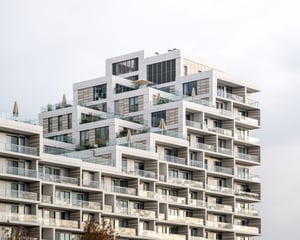
In June, on a Wednesday afternoon, the pool deck at Aquabella sits about thirty feet from Lake Ontario and almost nobody is on it.
That single line is most of what I'd tell anyone considering Bayside. The brochures sell the architecture and the lake views and the LEED Platinum plaque, and all of that is real. 3XN out of Copenhagen designed something genuinely beautiful. Inside, the 174 units do exactly what the floor plates promise. None of it is the reason to live here.
The reason to live here is the parts nobody photographs.
What nobody photographs
A condominium is an operating business that happens to have your bedroom in it. Most buyers, especially first-time downtown buyers, get sold on the photogenic version: the gym in the marketing render, a party room with one stylized couple drinking wine, a lobby shot in golden hour. After eighteen months inside Aquabella, the things that actually move a building from nice to well-built decade-out are almost entirely things you cannot photograph.
The security panel in every unit is wired directly to a desk that is staffed inside the building. Not contracted out, not monitored from a call centre two cities away, not a smart-home gimmick. Wired to a person who knows residents by name. Elevator etiquette at 11 pm, package handling at 4 pm, visitor protocol for guests heading up: not features you tour through, but exactly what a building feels like to live in.
Property management is responsive in a way that quietly compounds. The board doesn't cut corners. The underground garage gets cleaned twice a year, which sounds like a footnote and is not. Underground cleanliness is a leading indicator of how a board treats every unsexy capital decision the building will face for the next thirty years: the roof, the mechanicals, the window seals. The garage is the canary.
This is the kind of operational discipline that protects resale a decade out. It's also the kind that no marketing brochure will ever sell you on, because it doesn't render in 4K. The version of Aquabella that shows up in listings is the architecture. The version of Aquabella you actually live with is the operations.
Aqualuna is a masterpiece, and the gym is a tell
Right next door, the final phase of Bayside is Aqualuna. Same Tridel and Hines partnership, same 3XN architects, II by IV interior design, Janet Rosenberg landscape work. Two stepped towers facing the lake. LEED Platinum, like every Bayside building before it. Of the four phases, it's the most architecturally sophisticated, and genuinely a masterpiece. People walk down the slip and stop. That's the right reaction.
And then there's the gym.
The Aqualuna gym is small. Not in a "boutique" way. In a "the architects had a budget conversation and the gym lost" way. A real choice that real developers make when the proforma gets tight at the end of a phase, and Aqualuna is the end of the phase. Nothing controversial about pointing it out. The building is a masterpiece and the gym was where they pulled back. Both true.
The Aquabella gym is functional. Not enormous, not full-service, but functional in the way a building gym should be: equipment that works, maintenance that gets done, weights that aren't the same five dumbbells from 2014. You can run a real workout in it for sixty days in a row without ever thinking about leaving the building. That's the bar.
For a real lift, you walk to Unity Fitness on Downes Street. Forty-five thousand square feet, a saltwater two-lane pool, a full basketball court that doubles as pickleball, a Hammer Strength rack, ninety feet of turf with sleds. Open at 5:45 am on weekdays. The "your building gym is functional and your real gym is a five-minute walk" model is, I'd argue, the right model for downtown waterfront living, because asking a residential building to also be a destination fitness club is asking it to do the wrong job.
Aquabella does the right job. Unity is for when you want the other one.
The amenities you use, not the amenities you tour
The pool deck thing I opened with isn't poetic, it's data. The pool is busy on hot summer weekends, which it should be, and the deck on a Tuesday or Wednesday afternoon between June and September is one of the genuinely under-priced amenities in the building. Lake right there. Sun moves differently down at the water than it does inland.
The sauna takes time to warm up. Long enough that the first time you use it you'll wonder if it's broken. Once it's hot, a Tuesday-night sauna is a ritual that turns into a habit. You stop noticing the warm-up because you stop arriving cold.
The party room actually gets used. Real social events, real residents in it, not the staged version of community that most buildings put on a website and never deliver on. Which leads to the part nobody puts in a brochure.
The community is the part nobody puts in a brochure
Most downtown buildings sort by life stage. Twenty-somethings in one tower, young families in another, retirees somewhere quieter. Aquabella does not sort. Young families share the elevator with retirees. Couples without kids who plan to keep it that way are next door to single professionals. Mail-room conversations turn into dinner invitations. People stop each other in hallways and actually talk. The dog walkers know each other's dogs.
That isn't a normal downtown experience. It's closer to what people imagined the city was going to feel like before the city stopped feeling like that. I don't know exactly why this building skews this way. Some of it is unit mix. Some of it is who the building attracted in 2021. The rest is the staff, who set a tone of "this is a place where people know each other," and over time that tone becomes the culture.
Whatever the inputs, the output is a community that likes itself.
What's outside the door, today
What is outside the door is now better than what most of downtown can offer.
Sherbourne Common is the front yard. PFS Studio designed it, finishing in 2011 across two phases, and it's the first park in Canada to integrate a neighbourhood-scale stormwater treatment system with UV purification. Most people don't know parks have credentials. This one does. The skating rink in winter doubles as a splash pad in summer. A zinc-clad pavilion sits in the middle, the kind of public design most cities would be proud of and this one barely talks about.
Sugar Beach is across the slip, with the pink umbrellas and the candy-coloured rock that turned a sugar refinery's front yard into a postcard. The Martin Goodman Trail runs at the front door, which means an hour of waterfront on foot or on bike from Aquabella to Trinity Bellwoods or to the Beaches without ever crossing serious traffic.
Marché Leo's opened its largest location in November at 1 Edgewater Drive, anchoring First Capital's Bayside Village retail buildout. Forty thousand square feet, the chain's flagship "international market kitchen" format, and a real grocery store. Not a small-format pharmacy with a yogurt aisle. A real one. The Distillery District is a ten to fifteen minute walk north. St. Lawrence Market, the same. Water taxis are walking distance for an island day in summer.
Living anywhere downtown for a decade teaches you that "walkability" gets used loosely. This is the version that means it.
The trajectory is the part most buyers underestimate
What is being built around Bayside in the next five years matters more than what is here today, and what is here today is already good.
Biidaasige Park is the headline. Forty hectares, the Anishinaabemowin word for "sunlight shining toward us," the largest new park to open in Toronto in a generation. Phase one opened in July of 2025 with about fifty acres and a canoe launch into the new mouth of the Don River, the first time anyone has been able to launch a canoe there in a hundred years. The second phase opens in 2026 and brings the Lassonde Art Trail, the first art trail of its kind in Canada. The whole thing sits on Ookwemin Minising, the new island this project literally created. Federal, provincial, and municipal governments put 1.4 billion dollars into the flood protection that unlocked all of it. Ten to fifteen minutes on foot from Aquabella's front door.
Cherry Street has been realigned about fifty metres west of its old line, with sidewalks, a multi-use trail, and a future dedicated transit corridor. Quayside, the 4.9-hectare site directly east of Bayside, breaks ground this year. Dream Unlimited and Great Gulf are building it. First residents in 2031. Phase one includes 553 affordable rental homes, with 57 percent of them designed for families. That family focus matters. It changes who Bayside is going to be next to in five years.
The combination of finished public realm to the west, new park to the east, a new neighbourhood being built south of all of it, and the lake along the entire front, is a corridor that's going to look unrecognizable in 2031 in a good way. People who buy here in 2026 are buying into the second derivative.
The honest negatives
I won't pretend the trade is free.
Guest parking is limited around special events, which on a waterfront full of festivals, fireworks, and sailing weekends means there are stretches when finding a visitor spot is a project. Intermittent crack-repair work happens in the underground that produces sound that travels through the structure. Not constant, not loud. Present. The pool gets crowded on hot summer weekends. The Gardiner is audible through the day, more so during heavy traffic.
Billy Bishop is across the harbour. There's air traffic in the background, plus regular helicopter trips overhead. It's there. It is not loud. You stop noticing it the way people in Liberty Village stop noticing the GO train. The waterfront fireworks bring crowds. So do the holidays.
Across the slip on Polson Pier are Cabana and Rebel, which means in summer, on certain afternoons, you can hear house music drifting across the water. For some people that's a feature. Others would call it a deal-breaker. Both reactions are fair. It's worth knowing because the brochures will not tell you about it.
The biggest tradeoff is geography. South of the Gardiner is quiet. King West density does not exist down here. There is no 9 pm restaurant strip with twelve options inside three blocks. The neighbourhood is still being built, which means it will get there, but in May 2026 the count is what it is. If 9 pm Friday density is the deciding factor in a buyer's decision, Bayside is the wrong corridor.
The unexpected positives
There are birds. Living a block from the lake with this much new public realm being built around you means waking up and falling asleep with birdsong, in the literal core of the city. Most condo dwellers downtown have forgotten what that sounds like. Morning and evening light at the water is also a thing that most condo dwellers don't know they're missing until they have it. Lakeside light is different. Softer in the morning. Stays longer through the evening. Warmer at the shoulder hours than any inland exposure I've lived in.
You get those things back when you trade restaurant density for waterfront.
The trade, said simply
Move-down density. Lose the 9 pm restaurant strip. Trade away the Friday-night King West feeling.
Get back the lake every day. Real light. A building that runs the way buildings should run. Neighbours who actually like each other. A neighbourhood that was a third of itself two years ago and will be a different version of itself in five. Tridel-built premium product to live in while the rest of the corridor is being built around you.
That trade isn't for everyone, and it shouldn't be. The Bayside corridor is not in the business of being for everyone. The people who live here liked the trade. People who tried it and left would have hated it. Both true.
The piece I wish someone had handed me eighteen months ago was the one that named the trade exactly. So that's the one I wrote.
Related reading: Toronto Waterfront Condos in 2026 Complete Guide and Aquabella Toronto: What Buyers and Sellers Should Know.